
Blog Details
Why Database Design Matters in Web Development
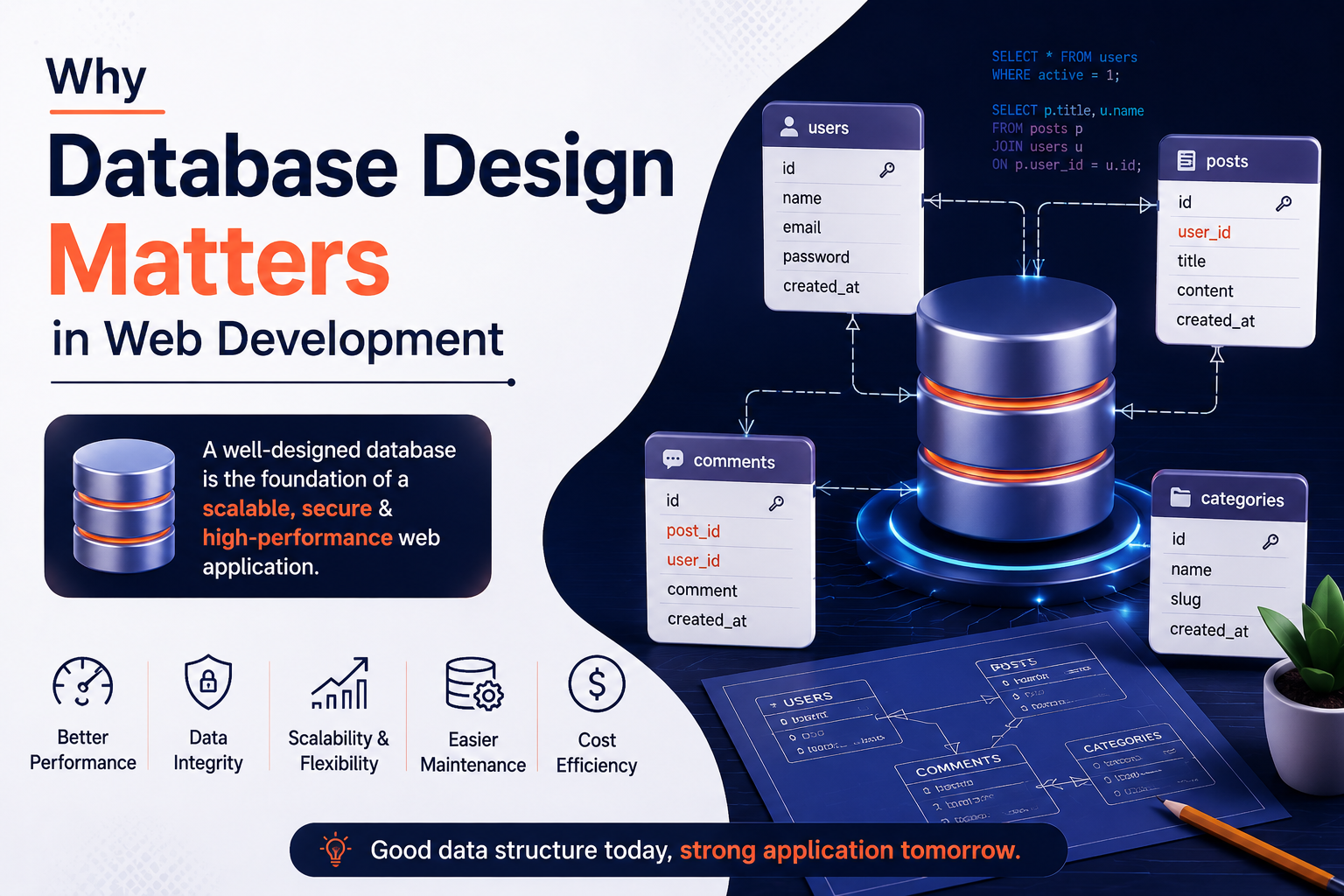
When people think about web development, they often focus on user interfaces, APIs, or backend logic. However, one of the most critical components of any successful web application is its database design. A well-designed database serves as the foundation of an application, ensuring that data is stored efficiently, relationships are maintained correctly, and the system remains scalable as it grows.
As a PHP and Laravel developer, I've learned that investing time in database design at the beginning of a project saves countless hours of debugging, optimization, and maintenance later. In this article, I'll explain why database design matters and the principles I follow when creating database structures.
What Is Database Design?
Database design is the process of organizing data into tables, defining relationships, choosing appropriate data types, and establishing rules that maintain data integrity.
A good database should be:
- Easy to understand
- Efficient to query
- Flexible for future changes
- Secure and reliable
- Optimized for performance
Whether you're building a blog, an e-commerce platform, or a CRM, the quality of your database design directly impacts the quality of your application.
1. Improves Application Performance
Poorly structured databases often lead to slow queries and unnecessary data duplication.
A properly designed database:
- Retrieves data faster
- Reduces server load
- Optimizes storage usage
- Handles larger datasets efficiently
Adding indexes to frequently searched columns can significantly improve query performance.
2. Reduces Data Duplication
Duplicate data creates inconsistencies and increases storage requirements.
Instead of storing the same information repeatedly, I normalize tables and create relationships using foreign keys.
For example, rather than storing a category name in every blog post, I store a category_id that references the categories table.
This approach keeps the data consistent and easier to update.
3. Makes Maintenance Easier
Applications evolve over time. New features, reports, and integrations often require database changes.
A clean database structure makes it easier to:
- Add new tables
- Modify existing relationships
- Generate reports
- Debug data-related issues
Good design reduces the risk of breaking existing functionality.
4. Ensures Data Integrity
A database should prevent invalid or inconsistent data from being stored.
I use:
- Primary keys
- Foreign keys
- Unique constraints
- Default values
- Proper data types
These constraints help maintain accurate and reliable information throughout the application.
5. Supports Scalable Applications
As user traffic grows, your database should continue to perform efficiently.
A scalable database design includes:
- Proper indexing
- Efficient relationships
- Optimized queries
- Minimal redundancy
Planning for growth early helps avoid major redesigns later.
6. Simplifies Relationships
Most web applications involve related data.
Examples include:
- Users and Orders
- Posts and Categories
- Products and Brands
- Students and Courses
Relational databases make it easy to connect this data using foreign keys.
In Laravel, these relationships are represented using Eloquent ORM methods such as:
- hasOne()
- hasMany()
- belongsTo()
- belongsToMany()
This keeps your application code clean and expressive.
7. Enhances Security
A well-designed database also contributes to security.
I follow practices such as:
- Granting minimum required database permissions
- Avoiding sensitive data duplication
- Using parameterized queries
- Encrypting sensitive information when necessary
Combined with Laravel's Eloquent ORM and Query Builder, these practices help protect applications from common database-related vulnerabilities.
8. Makes Reporting Easier
Clients often request reports and analytics after an application is deployed.
A well-organized database allows reports such as:
- Sales summaries
- User registrations
- Product performance
- Order history
- Revenue analytics
Without proper design, generating these reports can become slow and complicated.
9. Simplifies Team Collaboration
When multiple developers work on the same project, a consistent database structure improves collaboration.
Clear naming conventions and relationships make it easier for everyone to understand the data model, reducing confusion and development time.
10. Laravel Makes Database Management Easier
One of the reasons I enjoy working with Laravel is its excellent database tools.
Laravel provides:
- Migrations
- Seeders
- Factories
- Query Builder
- Eloquent ORM
- Database Transactions
These features help manage database changes consistently across development, testing, and production environments.
Best Practices I Follow
When designing a database, I aim to:
- Choose meaningful table and column names.
- Use the correct data type for each field.
- Add indexes to frequently queried columns.
- Normalize data to reduce duplication.
- Define foreign key relationships.
- Use timestamps for tracking records.
- Avoid unnecessary nullable fields.
- Plan for future scalability.
- Keep migrations organized.
- Document complex relationships when needed.
Final Thoughts
A database is more than just a place to store information—it's the backbone of a web application. Thoughtful database design improves performance, ensures data integrity, simplifies maintenance, and supports future growth.
As a PHP and Laravel developer, I treat database planning as an essential part of every project. Taking the time to design a solid database structure from the start leads to cleaner code, better performance, and applications that are easier to maintain as requirements evolve.